

Magic
Mana is the force flowing through the world and it can be perceived and directed through the practice and study of magic. A person's ability to influence the world around them through magic heavily depends on the strength of their aura, which is heavily influenced by their ancestry and thus their kindred. Regardless of aptitude or even the intention to practice magic professionally, every single person is born with an innate affinity, being either light or darkness, as well as an elemental talent, called a primary.
All magic, no matter how complex or simple the spell, rests upon the same principles: the ability to sense one's own aura, extend it outward, and bring it into harmony or tension with the surrounding flow of mana.
Terminology
Magic
Magic is the art of sensing, shaping, and directing mana through will and intent. It is not a force in itself, but the practice of using one. The term refers both to the act of influencing the world through mana and to the broader discipline surrounding its study and use.
Mana
Mana is the magical energy that flows through all sentient beings and permeates the world around them. It is the substance from which all magic is shaped and the force that allows spells to exist. While the term “magic” refers to the practice of casting spells, mana refers to the energy that makes such practice possible. If the art of running were compared to magic, then the strength of the legs would be mana.
Because mana is present within all sentient beings and may be directed at will, many describe it as though it were an invisible extra limb. A person learns to sense, move, and shape their mana much as they would learn to control a body part.
Aura
An aura is the personal mana field generated by every living being capable of magic, remaining present for as long as their mana lives. It surrounds the body as a manifestation of the individual’s mana, reflecting its strength, flow, and nature.
Example: He felt a nudge at his aura as his friend reached out through mana speech.
The term aura is also used to refer to the entirety of an individual’s mana. For this reason, the word is often used to describe a person’s overall magical capacity. A person said to have a “strong aura” is understood to possess large mana reserves.
Example: With an aura like that, she must be faekin.
In casual usage, the term aura can also refer to the grip/control a person exerts over an object through mana interaction, without specifying levitation, telekinesis, or other techniques.
Example: He startled and the book slipped from his aura, falling to the floor.
Affinity
Affinity describes whether a person’s magic naturally leans toward Light or Darkness. Unlike the elements, affinities exist on a spectrum rather than as two fixed opposites. Most individuals are born clearly aligned with one side, though some rare few fall near the middle, known as the Brink, where neither affinity is fully stable.
Example: Her affinity was Light. Meanwhile, his was Darkness.
Primary
The element one's mana most strongly responds to is called the primary. It is the element an individual naturally is the strongest in and will be able to master more demanding spells with than with their other elements.
Example: With his earth primary, he was prone to tripping.
Inverse
The element opposing an individual's primary element is called the inverse. It is impossible for the individual to ever use it.
Example: Since earth was her inverse, she was stuck in the collapsed cave.
Secondary
The secondary elements—often called simply secondaries—are the two elements that are neither the primary nor the inverse. An individual can use them to a limited extent and may even master them through sufficient practice, though they will never equal the strength of the primary.
Example: "Let's practice our secondaries today!"
Rules
-
Magic can only be cast when intention has been put into it. Unintentional spells usually derive from intrusive thoughts, vague but strong wishes, or reflexively being cast during a hallucinated/after a dreamt scenario.
-
The opposing affinity, as well as the inverse element, are inaccessible for an individual to use.
-
A caster's aura must be awake in order to correctly cast spells. Unconsciousness, delirium or dissociation hinder an intention to be expressed correctly and cause any spell cast under these circumstances to go awry or fail completely.
-
Only an awake aura can be properly assessed for its strength, as the aura of an unconscious individual does not produce any ripples in the surrounding mana that can be picked up on.
-
A person's mana cannot persist in spell-form after death
Magic Titles
When entering a Magic Academy, the military, or most professions involving magic, an individual’s magical capabilities are assessed and formally recorded. Although these capabilities can be improved through study and practice, doing so usually requires significant time, training, and expense.
Everyone starts with the Novice title by default. Most individuals remain there throughout much or all of their lives, particularly if they pursue occupations where advanced magic is unnecessary.
A person’s kindred does not affect their title, as each individual is judged against others of their own kindred. However, kindred still influences the raw strength of their mana. A rootkin Arcanist and a faekin Arcanist may share the same amount of training and education, yet the faekin will usually possess far greater mana reserves and overall magical strength.
The magic title therefore measures knowledge and practical mastery of magic rather than the amount of mana itself.
The titles are as follows:
Novice → Student → Arcanist → Luminary → Celestant/ Mythar
Novice
-
Has received no formal magic training whatsoever and is self-taught
-
Usually low magic skill (simple things like mana interaction, element manipulation, etc.)
Student
-
Is in the process of receiving formal magic training
-
Magic Academy students
-
Military training recruits
-
Privately tutored students
-
-
Usually advanced skill, depending on how long they’ve been learning
Arcanist
-
Has graduated with a verified skill level
-
From a Magic Academy
-
From Military training
-
-
Is allowed to take on missions rated for this title
-
Is now officially licensed to pursue the occupation of a mage
-
Can apply for jobs specifically suited for mages
-
Luminary
(locked)
-
Has furthered their studies after receiving the Arcanist title and has now graduated a second time with the title of Luminary
-
Writing a dissertation/research on a subject of magical interest, and having it approved, is crucial
-
-
More advanced technical magic skills than Arcanists
-
Title usually pursued by academics
-
There is a medical branch for the Luminary title which is pursued by doctors who aim to learn magic specifically for medical application
-
It is an extremely difficult degree to achieve and requires extensive study
-
Luminary medical degrees dor those with an affinity for darkness are not possible for anyone in Koruna. Even if they have made their degree elsewhere, it would not be counted as a medical degree in Koruna and they would be forbidden from practicing medicine.
-
Celestant | Mythar
(unavailable)
-
The highest title a mage can receive
-
Rewarded for exceptional magic skill in both strength, practice and education
-
Usually recipients are of older, wiser age
-
-
Title name varies depending on location
-
Celestant | Koruna, Caelmere, Alvaren, Coastal Region, stretches north up to Ravonne
-
Mythar | North Lands, everything north of Ravonne
-
-
Only a select few ever manage to receive this title and it’s the biggest honour when they do
-
They’re respected all around
-
Basics
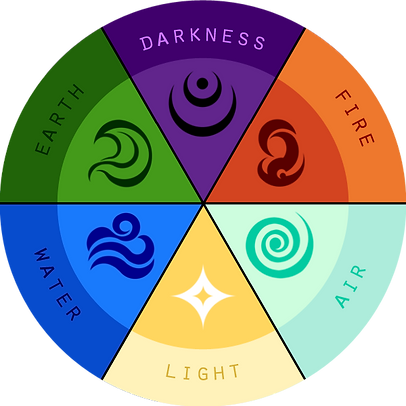
Magic is divided into two affinities—Light and Dark—and four elemental disciplines: Fire, Water, Air, and Earth.
Everyone is born with one affinity and a natural talent for one elemental discipline called a primary. The element and affinity directly opposed to these are called the inverse and they are inaccessible.
The two remaining elements are known as secondaries—they can be used to a limited degree but never with the same strength or precision as the person’s primary element.
A person's primary and affinity are rarely random. Both are usually inherited, passed down through generations or shaped by deep ancestral influence.
Each element also carries certain tendencies in temperament and ability, often giving rise to cultural stereotypes—though not all hold true. An earth mage is not inherently steadfast, nor must an air mage possess a melodic voice. Such traits may be common, but they are far from absolute.
Affinities
Affinities describe the direction in which a person’s magic naturally gravitates—toward Light or Darkness. Most individuals inherit the same affinity as one or both parents (when they share it), though on rare occasions, a child’s affinity manifests as the complete opposite.
Unlike the elements, affinities are not entirely fixed. Light and Darkness exist on a spectrum rather than as strict, opposing forces. While a mage clearly aligned with Light cannot perform Dark magic, the distinction becomes less defined closer to the middle of the spectrum—an area known as the Brink. The rare few individuals affected by this alignment, wavering between both sides, are called Brinkers, or are said to be on the Brink. This state is perilous, as it offers no stable connection to either affinity, making magic increasingly unstable and difficult to control.
This fluid nature of affinity has led to a common misconception: that Dark mages choose their alignment. While it is theoretically possible to shift from Darkness to Light, such a transformation is exceedingly rare and typically only occurs in those already near the Brink. Those deeply attuned to one side of the spectrum are anchored there by nature, with little ability—or choice—to change their affinity during their lifetime.

Light
Light Magic is the visible, stabilising aspect of mana—a force that nourishes, strengthens, and preserves. It enhances what already exists, guiding toward harmony and growth. While its physical applications include manipulating light, its essence lies in restoration, purification, and reinforcement.
At its highest level, Light Magic manifests as Blessings—enduring enchantments that infuse a target with stabilising or strengthening power. These are complex workings requiring immense control and intent, often bound to living beings, artifacts, or places.
Though generally constructive, Light Magic is not inherently benevolent. When misused, it can force unnatural growth, preserve what should decay, or overwhelm through excess vitality. Stability, when taken too far, becomes its own form of distortion.

Darkness
Dark Magic is the invisible, destabilising aspect of mana—a force of change, dissolution, and transformation. It alters what exists by breaking down the stable, reshaping form and essence alike. While its physical manifestations include manipulating shadow, its true domain lies in the unseen, the psyche and the mutable nature of being.
At its highest level, Dark Magic manifests as Curses—enduring enchantments that alter, corrupt, or bind through instability. These workings require precision and willpower, as their power lies in controlled transformation. A single misstep can cause them to unravel disastrously.
Dark Magic is not inherently malevolent. When guided with discipline, it can soothe unrest, rewrite the body, or strip away what harms. Yet its very strength—the power to change—makes it perilous. Left unchecked, it consumes balance, erodes form, and leaves only chaos in its wake.

Elements
There are four elements in existence: Fire, Water, Air and Earth, most often also counted in that order in academics.
Everyone is aligned most strongly with one singular of the four elements. This alignment is often heriditary, but deviations can also occur. This main element is called the primary.
Aside from someone's primary, they also have something called the inverse. This would be the element that contradics the primary, and the individual is unable to ever use this element. Not even the strongest, most talented mages—including the fae—are able to use their inverse.
The contradicting elements are the following:
Fire
Earth
↔
↔
Water
Air
Last but not least there are the secondaries. These are the two elements that are neither the primary, nor the inverse. The individual gets to use them both freely, though they will never be able to use them as strongly and as masterfully as they can use their primary element.
Since not everyone is a mage by profession, the general term to refer to someone is by their primary, followed by the term elemental.

Fire
Fire is the most volatile and inherently destructive of the elements and therefore requires careful precision and constant awareness to handle. Those who master it are known for endurance, precision, and control under pressure. Its magical application includes shaping heat, flame and combustion through the caster's mana. Fire-elementals primarily channel their primary through emotion, which means that passion, determination, and willpower can strengthen their output. Because of this, emotional instability or loss of focus can cause fire spells to flare out of control.
Typical applications include:
-
Heat control: regulating temperature for forging, cooking, or environmental survival.
-
Illumination: creating and maintaining magical fire for light sources.
-
Combustion and projection: casting fireballs, flame bursts, or jets of heat.
-
Purification: burning out impurities or cleansing corruption (Light affinity).
-
Destruction: searing or withering targets (Dark affnity).
Fire elementals are often associated with strong emotional outbursts, ambition, and a strong will. They tend to act decisively, pursue goals with intensity, and respond quickly to challenges. While this can make them bold and courageous, it also gives rise to stereotypes of impulsiveness or impatience. These traits are tendencies rather than rules—many fire elementals are careful and strategic despite the element’s energetic nature.
Due to being most comfortable around fire as an element, as well as the intrinsic emotional ties they have to the element, fire elementals also have a higher chance of developing pyromania than anyone else.


Water
Water is characterised by its ever-changing, fluid nature, requiring adaptability and thinking ahead. Those who master it are known for their patience, composure, and strategising abilities. Its magical application is mainly the art of manipulating or conjuring the element in all three of its forms: water, ice and gas. Water-elementals channel their primary through visualisation and careful guidance. Those to make the mistake of underestimating water's fluid nature, will learn that it can quickly become an unstoppable force when not guided carefully. It is therefore a core technique of any magical education to learn to read water currents and how to move in harmony with them.
Typical applications include:
-
Shaping and directing liquids: controlling streams, flows, or small bodies of water.
-
Ice manipulation: forming shields, walls, projectiles, or freezing surfaces.
-
Environmental adjustments: redirecting currents, forming temporary ice bridges, or altering water levels for short-term effects.
-
Temperature control: heating or cooling water or ice temporarily.
Water elementals are often associated with calmness, flexibility, and strategic thinking. They tend to be observant, methodical, and able to adapt to shifting circumstances. While they may appear gentle or reserved, their focus allows them to act decisively when required.


Air
Air is commonly the most underestimated and most versatile of the four elements, due to it consisting of the unseen forces of the atmosphere. To master it means to be flexible above everything else as air is in constant motion and therefore demands constant supervision. Its magical application usually includes the manipulation of pressure, winds and sound, as well as finding various uses in terms of improving or manipulating mobility. Most air elementals are always acutely aware of the air currents around them and know exactly when to tap into them, disrupt them, or when to let go.
No air elemental or even mage has enough mana strength on their own to cause wide-scale disasters like storms, but they do have the ability to start chain reactions, especially when cast by an entire group, that could naturally form storms when the conditions are right. Usually, the worst thing to get out of control is a stray wind gust when handled carelessly.
Typical applications include:
-
Pressure control: compressing or dispersing air to create barriers, shockwaves, or cutting streams of concentrated airflow.
-
Mobility: lightening the body, slowing falls, gliding, or enhancing leaps through controlled air currents.
-
Sound: carrying voices across distance, dampening noise, or amplifying vibrations in the air.
-
Wind manipulation: generating gusts, directing currents, or creating bursts of force to push, deflect, or reposition objects and targets.
Novices often underestimate the element, which leads to distraction, impatience or hesitation that easily result in a spell going awry. Anyone who wants to become a good air mage therefore needs patience, flexibility and precision as core traits.
Air elementals are often associated with precision, quick thinking, and heightened awareness of their surroundings. They tend to be attentive and perceptive, noticing subtle changes that others might overlook.
Because air magic relies heavily on control and concentration, air mages sometimes develop perfectionistic tendencies or become easily frustrated when conditions disrupt their focus.
Due to the manipulation of sound being one of air's core disciplines, the trait of having a pleasant voice gives an air mage a further advantage. While it is not guaranteed that air mages have plasant voices or are good singers, it has become a common stereotype that they are.


Earth
Earth is the slowest but also strongest of the four elements, represented by the tallest mountains as well as the smallest flowers. To master it means to master one or both branches in which it expresses itself: minerals and plants. Compared to the other elements that are always in some sort of movement, earth is resistant to sudden change. Patience and in some parts also stubbornness are required to overcome its natural inertia and make it bend to one's will. Especially the art of manipulating or conjuring plant life is one requiring excessive patience and a feel for the flow and need of nutrients, as well as the soil itself.
Typical applications include:
-
Reshaping: manipulating the ground to form something currently required, like a stop, a stand, a wall, etc.
-
Cleaning: separating dirt and grit from other materials, or removing mud from paths and surfaces.
-
Plant growth: accelerating the growth of existing plants by guiding the distribution of nutrients and the conditions needed for development.
- Gardening: loosening soil, removing unwanted roots, or encouraging flowers and other plants to grow.
- Mineral manipulation: extracting, separating, or shaping minerals and stone for construction, craftsmanship, or other practical purposes.
Earth elementals are often associated with patience, determination, and dependability. They tend to be persistent in pursuing their goals and prefer building lasting solutions over seeking immediate results. While these traits can make them reliable and difficult to discourage, they may also develop a reputation for stubbornness or resistance to change. These tendencies are not universal, and some earth elementals are far more adaptable than their reputation suggests.
Earth magic rewards those who understand that strength does not always come from force. Manipulating minerals requires an understanding of structure, pressure, and the natural properties of the material, while cultivating plant life demands an awareness of growth, nutrients, and the surrounding environment. Those who lack patience may find earth frustratingly slow to respond, as attempts to force rapid changes can result in unstable structures or unhealthy plant growth.

The Septagram
The septagram is a seven-pointed star drawn with a single, continuous line that crosses itself. It represents the seven main branches of magic: the four elements of Fire, Water, Air and Earth, the two affinities of Light and Darkness, and Mana Interaction, the manipulation of mana before it takes on an elemental form.
Once a symbol used exclusively by the fae to mark places of magic, the septagram has since become a widely recognised symbol of magic throughout Mereldia. It is used by magical institutions and organisations, and can be found on mage certifications and other items associated with the practice of magic. Businesses and establishments that rely heavily on magic in their everyday operations may also bear the symbol. However, only magic academies are permitted to include the septagram in their coat of arms.
The misuse of the symbol or misrepresentation of its meaning is prohibited by law.

Your Character
Your character will be able to start off with one of three titles:
-
Novice | 1-2 spells
-
Student | 2-5 spells
-
Arcanist | 5-10 spells
The Luminary title is locked and the Celestant/Venerant/Mythar title is unavailable due to its extreme rarity! Your character's magic title is determined by their magical education, which means the magic system is story-based, not level-based.
-
If your character never received formal magic training, then they will be a Novice.
-
If they are still in training, then they're a Student.
-
If they have finished their training, they'll be an Arcanist.
Depending on your title, you will be able to start out a certain number of spells that apply to that magic skill. The spellbook has a skill level categorisation, so while characters with a higher magic title are freely able to choose lower magic skill spells, those with a lower title won't be able to choose higher-ranked spells. Further spell slots can be attained through levelling.
The title of Luminary can be attained when your character attends a magic academy in-story and works on a luminary thesis.
Please keep in mind that magic has limits. No mage, regardless of kindred or magical title, can cast spells on the scale of city-engulfing infernos, tsunamis, earthquakes, or tornadoes. The amount of mana and control required simply exceeds what any individual can possess.