

Eriwon
Eriwon lies east of Koruna and south of the outer reaches of the Veil mountain range. Long ago, Korunan emigrants settled here in 142 A.W. and shaped it into the prosperous nation it is today alongside its native inhabitants. Their arrival did not drive away the demons that still roam Eriwon’s wilds to this day, but it allowed cities and countless small villages to take root instead of the wildlander lifestyle the inhabitants practiced before that.
The first of these settlements was Wonsu, which over time grew into the magnificent capital it is today.


MAP PLACEHOLDER
Geography
Eriwon is a land of countless small villages. No other country in Mereldia has such a dense spread of settlements; within a hundred-kilometer radius, towns and hamlets lie so close together that one rarely travels more than a day or two without encountering one. As a result, Eriwon is considered the least wild region in all of Mereldia.
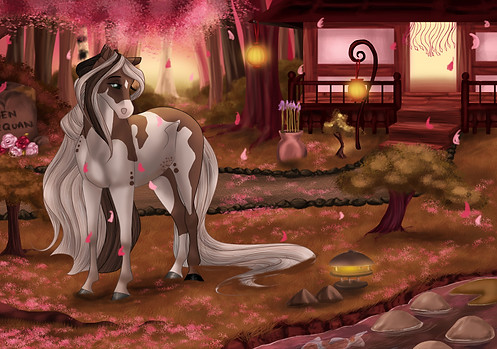
The landscape is fertile and temperate. Cherry trees dominate much of the countryside, especially in the lowlands, where rivers cut through green forests and irrigated fields. Rolling hills and wooded valleys provide natural borders between settlements, while waterways serve as trade routes and lifelines. Compared to harsher regions such as the Korunian desert, Eriwon appears gentle and welcoming—its dangers rarely obvious at first glance.
Dangers
Despite its welcoming appearance, Eriwon is far from safe once one strays from the roads or settled land. Demonkin are a common presence in its wilder regions, frequent enough that dedicated demon hunters operate throughout the country, tasked with protecting smaller villages and travellers. Attacks occur regularly, particularly against those who wander alone.
Not all demons are hostile, but most are treated as such, and the distinction is rarely made in moments of danger. Their long-standing presence has left a visible mark on Eriwon’s society, including the notable number of half-demons that appear in slave markets.
Eriwon is also home to faekin such as kitsune, soul pipers, moon birds, and other immortal beings. While many of these creatures are not inherently dangerous, they are regarded with caution. Immortality itself is met with distrust, and few locals are willing to assume peaceful intent—especially beyond the safety of village boundaries.
Apart from demons, the native flora and fauna should also be met with caution, especially in the south where the landscape is scattered with marshes and bogs. Predators like the extremely dangerous kelpie raptor or the southern mountain raptor can become an immense danger to unprotected travellers or remote villages.
Social Order
When you live in Eriwon and especially in one of its big cities, there are certain social structures you have to keep in mind. Similar to Koruna, there is also a hierarchic system in place here that divides the sociaty into different parts.
Royalty
King
Royalty
High Society
Commoners
Streetfolk
Blighters
King
Queen
Royal Concubines
Nobility | Officers | Academics
artisans | merchants | skilled workers
The Poor | Criminals
Slaves | Outcasts
The king of Eriwon is widely respected, and his authority is rarely questioned. His decrees carry the force of law and are expected to be followed throughout the country. While he is not worshipped as a god—as is the case in Koruna—he is held in great esteem as the embodiment of the state and its traditions. To act against the king is seen as an act against Eriwon itself, and serious acts of betrayal are met with the harshest punishments.
Queen
The queen of Eriwon serves as the foremost ceremonial and diplomatic figure of the realm. She embodies continuity, grace, and the legitimacy of the royal line, and her presence is central to court life. As consort to the king, she is expected to secure the succession, but her influence extends far beyond bearing heirs.
The queen oversees the inner court and the royal household, including the harem, and is responsible for maintaining harmony, discipline, and political balance within it. She often acts as an intermediary between the throne and the court, advises the king on matters of tradition and internal affairs, and represents Eriwon in formal audiences, rituals, and alliances. While ultimate authority rests with the king, the queen’s word carries significant weight, and few decisions within the palace are made without her awareness.
Royal Concubines
The royal concubines are mares bound to the crown, usually drawn from noble families or taken as a political consequence. They are not allowed to leave the inner palace. While their role includes attending and entertaining the king, their greatest significance lies in succession.
Any concubine who bears an heir may rise in status, making the concubines’ quarters a place of constant rivalry. Poisonings, betrayals, and sudden “illnesses” are an unspoken reality, and survival depends as much on caution and alliances as on favour.
High Society
High Society in Eriwon consists of noble lineages, influential families, and individuals whose wealth, education, or service places them close to the court. This includes ranking officials, military officers, scholars, and those entrusted with ceremonial or administrative duties. Members of High Society are expected to uphold tradition, refinement, and public decorum, and their conduct reflects not only on themselves but on their families.
Commoners
The Commoners form the working heart of Eriwon’s cities and villages. Artisans, merchants, craftsmen, and skilled laborers belong to this class, maintaining trade, production, and everyday services. They run workshops, markets, and businesses, and many pass their trades down through family lines. While their lives are modest, diligence and mastery of one’s craft are highly valued, and success can elevate a family’s standing over time.
Streetfolk
Streetfolk live on the margins of Eriwon’s cities and villages, eking out a living through informal labor, odd jobs, or small-scale trade. Many turn to theft, smuggling, or other petty crimes to survive, while others work as guides, messengers, or assistants in the markets. Homes are often temporary or shared, and life demands ingenuity, resourcefulness, and caution. Though viewed as lower in the social order, Streetfolk form tight-knit communities, relying on networks of trust, knowledge of the streets, and skillful navigation of both law and local custom to endure.
Blighters
Blighters occupy the lowest tier of Eriwon’s society, consisting of slaves, outcasts, and demonkin. Feared and mistrusted, many live at the edges of towns or in hidden settlements, subjected to harsh labour and strict oversight. Slavery is common, with property clearly marked—bridles, collars, even brands—signifying ownership. A Blighter has little social standing, and survival often depends on obedience, discretion, and the protection of patrons or allies.
Everyday Life
Life in the land of cherry blossoms is guided by tradition, ceremony, and social expectation. From dawn to dusk, residents adhere to strict manners and measured politeness, treating family, neighbors, and strangers with formal respect. Hospitality, modesty, and attention to social hierarchy are deeply ingrained, and even minor lapses can bring embarrassment or shame.
Work is highly valued, and skill in one’s craft—whether as an artisan, merchant, scholar, or soldier—is a mark of personal and familial honor. Shops, workshops, and markets bustle with activity from early morning, and many families pass down trades from generation to generation. Education is prized, and children learn not only their craft or trade but also proper etiquette, loyalty to family, and the history and rituals of Eriwon.
In private and public life alike, people carefully observe others, taking cues on what is acceptable and expected. Standing out or acting recklessly is discouraged; those who follow established ways are quietly respected, while those who fail to meet expectations risk bringing dishonor upon themselves or their family.
Even leisure reflects these values. Tea ceremonies, seasonal festivals, and communal celebrations reinforce social bonds, ritual observance, and the appreciation of artistry and refinement. Music, poetry, and performance are carefully honed and shared according to custom, and public displays of emotion or behavior are measured and deliberate.
For travelers and newcomers, blending in requires patience, attentiveness, and humility. Life in Eriwon rewards discipline, caution, and respect for tradition, creating a society where daily routines, work, and social interaction are deeply intertwined with honor, reputation, and the continuity of the community.
Your Character
-
Raccardis are also a common thing to own in Eriwon. That or another kind of slave. If your character is Commonfolk or higher, then they most probably own at least one slave
-
you may design one as an NPC for free or use a group adoptable designed for that purpose
-
-
Your character will likely speak in the Eriwonese dialect, but you are not required to write it out in writing and roleplays. It is a stylistic choice you can choose to apply or not to apply.
-
Your character does not have to celebrate all of the festivals, but at least the religious ones!
-
Your character will know Eriwon's lore and be wary of anyone who looks suspicious, fearing that they might be demonkin
-
They will talk bad about people who live in the "wild lands," refering to them as Wildlanders. They are seen as uncivilized and some people even think of them as witless.
-
Clothing is not necessary for your character, but wearing it signals status, refinement, and adherence to social norms
-
finely made garments reflect wealth, skill, and family standing
-
More information can be found on the lore pages. The section for Eriwon in particular can be found here.