

Dark Magic is the invisible, destabilising aspect of mana—a force of change, dissolution, and transformation. It alters what exists by breaking down the stable, reshaping form and essence alike. While its physical manifestations include manipulating shadow, its true domain lies in the unseen, the psyche and the mutable nature of being.
At its highest level, Dark Magic manifests as Curses—enduring enchantments that alter, corrupt, or bind through instability. These workings require precision and willpower, as their power lies in controlled transformation. A single misstep can cause them to unravel disastrously.
Dark Magic is not inherently malevolent. When guided with discipline, it can soothe unrest, rewrite the body, or strip away what harms. Yet its very strength—the power to change—makes it perilous. Left unchecked, it consumes balance, erodes form, and leaves only chaos in its wake.
Darkness

Summary
Curses
Element: None
Recommended Level: Arcanist
Invisibility
Element: None
Recommended Level: Arcanist
Dark-affinity invisibility conceals a creature or object by directly influencing the perception of observers. The spell interferes with the mind’s ability to register, prioritize, or acknowledge the target, causing it to be subconsciously ignored or mentally excluded from awareness.
The target remains physically present and can interact with the surroundings normally, but affected observers fail to consciously perceive or retain awareness of them. However, the caster retains full perception of their own body and equipment while the spell is active.
Each observer must be individually encompassed by the glamour, making the spell efficient in sparsely populated areas but increasingly taxing in crowds. Newly arriving observers are unaffected unless the spell is actively extended.
Strong willpower, heightened awareness, or magical sensitivity can weaken the effect, often causing unease or momentary recognition. Direct interaction may further disrupt the spell.
Dark invisibility may be cast directly or imbued into a conduit as an enchantment. Like all enchantments, it is temporary and ends once its stored mana is depleted.
Common uses: infiltration, social evasion, targeted concealment
Notable drawbacks:
-
Each observer must be individually affected, making the spell inefficient in crowds.
-
New arrivals are not automatically concealed from.
-
Strong minds or magical senses may partially resist or detect the effect.
-
Mental strain increases rapidly with range and number of targets.
Light Counterpart: Invisibility
Siren Voice
Element: Air
Recommended Level: Student
The spell is the art of weaving dark-aspected mana into spoken sound so that the caster’s voice carries compulsive influence. Sound lies within the jurisdiction of air and thus serves as the medium through which this woven mana travels.
When heard, the listener’s resistance weakens, suggestibility rises, and critical judgment dulls. With sufficient exposure, suggestions may take root and commands may be accepted that would otherwise be refused. The spell does not impose instant domination, and commands that directly violate survival instinct or core identity remain difficult to enforce.
To the affected listener, the caster’s voice acquires a heightened allure. It may be perceived as unusually beautiful, soothing, or compelling, regardless of its natural quality. This alteration purely perceptual, arising from the spell’s manipulation of emotional response and attention.
Effectiveness is influenced by several factors:
-
Sustained exposure deepens the influence.
-
Melodic phrasing strengthens stability.
-
Rhythm, repetition, and sustained tone provide a more reliable vessel for dark mana, which is why the practice is traditionally associated with song.
-
-
Emotional receptivity further lowers resistance.
-
Attraction, admiration, trust, or fascination toward the caster make the spell more potent, with romantic or physical attraction producing particularly strong susceptibility.
-
The spell does not create attraction where none exists, and strong aversion or indifference may greatly reduce or nullify its effect.
-
-
Distance, obstructed hearing, or disrupted airflow may destabilize the woven mana before influence is fully established.
Limitations:
-
Requires clear auditory contact
-
Effect weakens with distance, noise, or obstructed airflow
-
Strong-willed or magically shielded targets may resist
-
Influence builds gradually and requires sustained exposure
-
Influence is significantly reduced if the target feels no emotional receptivity toward the caster
Sleep
Element: None
Recommended Level: Student
The spell induces sleep by guiding dark-aspected mana to calm the mind and reduce mental activity. The caster focuses this energy on the target’s aura, promoting relaxation and lowering resistance to rest. As the mind quiets, the body naturally follows into a state of sleep.
Effectiveness depends on the caster’s skill and the target’s receptivity. Subtle control of the mana’s flow is required to avoid agitation or overstimulation. The spell can be applied to individuals or small groups, provided attention is maintained to each recipient’s response.
Common uses:
-
Helping restless or anxious individuals to sleep
-
Creating temporary periods of calm in living or work environments
-
Reducing mental stress for short-term relief
Notable drawbacks:
-
Overuse may leave the target drowsy or mentally sluggish
-
Resistant or strong-willed subjects may require repeated application or higher skill
-
The spell works on the mind and cannot correct physical exhaustion or underlying medical issues
Light Counterpart: Sleep
Transformation
Element: None
Recommended Level: Varies (Arcanist at least)
Transformation is a broad category of magic concerned with altering the form, structure, or properties of an existing target. The underlying principle remains the same across its many applications: mana is used to reshape the target according to a desired outcome. The complexity of the transformation depends on the nature of the target and the extent of the changes being made.
Transformation is among the most challenging forms of magic to perform and requires enormous mana reserves, even for relatively simple applications. The more fundamental the changes, the greater the precision and mana required to achieve them without damaging the target or producing an unintended result. Transformation therefore covers a wide range of difficulties, from reshaping an ordinary object to altering a living body at the level of its species.
The following scale illustrates the approximate difficulty of different transformations, from 1 (simplest) to 10 (most difficult):
-
Reshaping an object: Changing the shape of an object without altering the material it is made of.
-
Reassembling broken objects: Fusing broken pieces back together to restore the original object.
-
Altering non-magical organisms: Changing a plant or non-sentient animal to develop particular traits.
-
Changing superficial bodily traits: Altering one's own appearance, such as changing fur colour, without changing the underlying structure of the body.
-
Changing material composition: Transforming one material into another, such as turning wood into wax.
-
Altering specialised bodily features: Changing a limited part of one's own body, such as the eyes, to acquire different physical capabilities, such as night vision.
-
Creating additional bodily features: Forming new features from mana, such as wings.
-
Transforming into another species: Altering one's entire body to take the form of a different species.
-
Transplanting body parts: Integrating a foreign limb into another body through magical transformation.
-
Creating a hybrid form: Transforming one's body into a combination of different species.
These levels are indicative rather than absolute. The difficulty of a transformation can vary depending on the target, the extent of the changes, and the mage's familiarity with the desired outcome. Living organisms are particularly challenging because their existing structures must be altered without compromising their continued function.
Most rootkin mages are unable to perform transformations beyond level 5, while even accomplished faekin mages find the upper levels difficult. Transformations at level 8 or above require extensive study and dedicated specialisation in the field. Only a small number of mages possess the knowledge, control, and mana reserves necessary to perform them reliably.
Transforming one's own body is particularly difficult, as not only does the body need to remain functional throughout the casting process, but the aura naturally rebels against altering physically into something foreign. Errors such as misplacing or omitting vital organs can cause severe trauma, interrupting the flow of mana and ending the spell prematurely. In most cases, the body reverts to its original form when the mana supply is interrupted, provided the mana has not been exhausted by the spell. If a failed transformation spell has been cast to the point of mana sickness, then any changes that leave the body in a state incompatible with survival are beyond its natural ability to revert back to a functional state. Such cases require immediate medical attention.
Knowledge and Specialisation
Successful transformation requires more than the ability to manipulate a target's form. Whenever a transformation must produce a functional result, the mage needs an extensive understanding of the target's intended structure and how its individual parts work together. Transforming a body to resemble another species, for example, requires knowledge of its anatomy, including the arrangement and function of its organs, muscles, bones, and other structures. Even a minor mistake can leave the transformed body impaired or unable to survive.
This requirement applies to objects as well. A mage who wishes to transform an object while preserving its function must understand how its components fit and work together. The greater the structural complexity of the target, the more demanding the transformation becomes.
For most mages, this knowledge must be acquired through extensive study and practice. Certain fae, however, possess an innate aptitude for body transformation and grow up with an intuitive understanding of alternate forms, much as a person acquires their mother tongue. Pookas and kitsune are particularly adept at this, having a natural familiarity with the forms they can assume.
Due to its risky and immensely challenging nature, the art of bodily transformations is not widely spread. Smaller, simpler transformations, especially in terms of mending, are much more common.
Common uses:
-
Reshaping objects to create a desired form or repair minor damage.
-
Altering the shape or appearance of crafted goods during production.
-
Changing the colour, texture, or other visible properties of materials.
-
Modifying the traits of plants to encourage desirable characteristics.
Notable drawbacks:
-
The difficulty of a transformation increases with the extent and complexity of the changes required.
-
Functional changes to objects or living organisms require extensive knowledge of their structure.
-
Bodily transformations are exceptionally risky, as errors can impair bodily functions or cause lasting damage.
-
Complex transformations can exhaust the caster's mana reserves and cause mana sickness.
Umbral Wings
Element: Air
Recommended Level: (advanced) Student
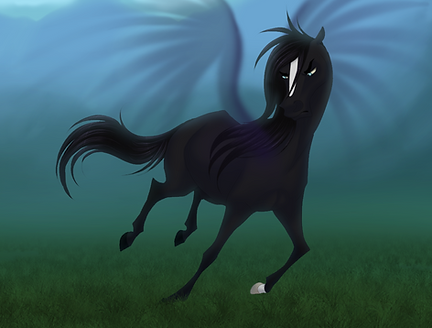
A variant of the flight spell that visualises non-existent wings as an addition to controlling the airflow. The base consists entirely of the air-aligned part of the spell, which enables flight, while the affinity-aligned part is a minor addition usually used for orientation purposes and to keep track of which part of the surrounding air is currently being manipulated. Since air is largely invisible, a visualisation can help mages maintain their orientation, especially beginners. Most mages also prefer having visible wings to make flight appear more natural, as hovering without any visible means of remaining airborne can look rather uncanny.
The Umbral version of the spell is used by air mages with an affinity for darkness. The wing shape is formed by manipulating shadows or creating a void-like formation by banishing light from the space where the wings should be. This can be expressed in many different shapes and forms. Since the visualisation is purely optical and has no physical structure, the wings do not need to be aerodynamic, though most mages prefer a close approximation of real wings.
Common uses:
-
Sustained flight and aerial manoeuvring.
-
Providing a natural-looking visualisation for magical flight.
-
Helping inexperienced mages maintain their orientation while learning to control airflow.
Notable drawbacks:
-
Flight requires continuous control of the surrounding airflow, which can be demanding for inexperienced mages.
-
The visualisation does not provide lift or physical support; flight depends entirely on the air-aligned part of the spell.
-
Maintaining flight for extended periods can exhaust the caster's mana reserves and cause mana sickness.
Light Counterpart: Astral Wings
Voice Projection
Element: Air
Recommended Level: Student
The spell allows the caster’s voice to bypass physical barriers by using dark-aspected mana as a temporary conduit. While sound normally travels through air, dense obstructions prevent its natural propagation. By weaving dark mana into the voice, the caster encodes the sound as a psychic-mana signal that moves independently of the air, carrying the tonal and linguistic information across the obstruction. Once the signal reaches open air, it materializes as audible sound, allowing listeners to hear the voice as if it had traveled normally.
Unlike suggestive spells, this technique does not influence emotions, perception, or judgment. Its purpose is strictly to transmit speech or signals where normal sound cannot reach.
This spell is especially useful in emergencies, warning allies, or summoning aid through inaccessible terrain. The caster must still rely on air alignment to allow the voice to propagate naturally once the dark-mana bridge reaches open space.
Limitations:
-
Requires continuous focus; if the caster falters, the signal collapses.
-
Mana cost rises with distance and the density or thickness of obstacles.
-
Extremely dense or magically reinforced barriers may block the signal entirely.
-
The voice can only emerge in open air; it cannot be projected directly into a listener’s mind.