
The World of Mereldia
Long before recorded history, in an age so distant that no living memory reaches it, the First Folk (humans) destroyed themselves through the reckless misuse of magic. In their arrogance, they shattered Mereldia alongside their own civilisation, leaving behind a world scorched, broken, and decaying.
In the aftermath, powerful fae were bound to the remnants of the land. Later revered as gods, each was given dominion over a fragment of Mereldia and charged with restoring life to what had been ruined. From these ancient fae all later societies would arise.
For many millennia, the gods governed their lands in isolation. Sentience, language, and culture formed beneath their influence. This age came to a violent end when war broke out among the gods themselves. Most were slain before divine judgement fell; those who survived withdrew from the world, vanishing into seclusion. A rare few—such as the guardians of Nordberg—remained, choosing to shelter and guide the mortals left displaced by the devastation.
This period marks the beginning of recorded history, scripture, and civilisation. All dates are counted from this turning point and are marked A.W.—After the War.
Now, 1,320 years later, Mereldia has rebuilt itself from the ashes. Nations have risen, borders were drawn, cultures have sharpened, and systems of rule were established. Though the gods are gone or silent, their legacy remains in the land, the people, and the magic that still lingers in the world.
In Mereldia, mortal creatures are divided into two categories: the sentient and the witless. Nearly every kind of mortal creature exists in both sentient and witless forms.
Sentient
Sentient beings are capable of reasoning, speech, and culture. Their intelligence traces back to the age of the gods. In each land, the ruling god (fae) held a specific animal form. Only animals of that same species were able to intermix with the god of their land, and through this divine lineage inherited sentience. Over many millennia, these descendants became fully intelligent mortal beings of distant fae origin.
Because this process depended on the god that governed a land, sentience is not universal within a species. A creature may be sentient in one region and entirely witless in another. For example, a land once ruled by a deer-god produced sentient deer, while all other animals there remained witless. Elsewhere, a crow-god may have granted sentience to corvids, while deer in that land never gained intelligence.
Physical differences
-
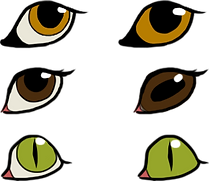
white sclera
-
capable of magic
-
visual traits unseen in animals
-
wide variation of iris colours
-
unusual patterns & colourations
-
-
longer life spans of ca. 100 years (they age like humans)
-
omnivorous regardless of species
The sentient are simply referred to as people.
Witless
Animals that did not intermix with the gods remained without intelligence. They act purely on instinct and lack speech, reasoning, or culture. These creatures are known as the witless, though they are commonly referred to simply as animals.
People keep them as livestock, hunt them for meat, or keep them as pets. It is often regarded as uncanny to handle an animal of the same species as oneself, which led to a lot of variations in the choice of draught and farm animals.
The Sentient & The Witless
Sentient
Witless
Kindred
A person’s kindred describes the origin of their nature—physical form, magical expression, and inherited traits. There are four recognised kindreds. For an extensive description of each kindred go here.
Rootkin
The most common kindred. Rootkin are people whose sentience stems from distant fae ancestry. Their magical origin lies far back in history, diluted through countless generations, resulting in forms considered natural and culturally typical for their land. While they all possess magic, it is subdued compared to that of the fae. While their eyes can take on almost any colour, the rest of their appearance is kept in natural colours.
Chimera
This kindred encompasses beings formed from the merging of multiple creature forms, such as gryphons, pegasi, kirin, raccardi, and similar hybrids. Chimeras are defined by their composite nature rather than their magical capacity and thus are usually judged on a case-by-case basis when registering for something where magic is a requirement. Additionally to features unnatural to rootkin, they can also sport splashes of unnatural colours, though those are usually singular accents instead of a fully unnatural appearance.
Demonkin
Back in the Great War, the warring gods created creatures in their own image out of dark magic to help them fight—they became known as demons. They have nothing to do with summoned entities—like constellation beasts—and are rather beings in-between rootkin and faekin in terms of magical capabilities.
Demonkin are those marked by this demonic descent or influence. This may manifest physically, magically, or behaviourally, and includes any person whose nature has been shaped by demonic magic, regardless of how distant that influence may be.
While widely varied in appearance, demonkin usually showcase unnatural colours and features—such as the characteristic swirl-shaped markings known as demon marks. Such features are not, however, a reliable identifier since they can also look like rootkin or chimeras in appearance, making it difficult to distinguish them at a glance.
Faekin
Faekin include the fae themselves as well as those whose nature is directly shaped by fey influence. This kindred encompasses full fae, their immediate descendants, and other beings whose bodies, magic, or behaviour follow fey laws rather than mortal ones.
Caspanas are classified as faekin despite lacking fae descent, as their nature and physiology aligns inherently with fey principles.
Calendar
The Mereldian calendar differs from ours and is based on the Coligny calendar, which includes leap months, a different beginning/end of the year, as well as different month lengths. The full Mereldian calendar, complete with moon phases, celebrations, etc. can be found here.
Months of the year
Roman Calendar Date
Mereldian Calendar Month
Duration (in days)
Number
May 16 – June 14
June 15 – July 13
July 14 – August 12
August 12 – September 11
September 11 – October 10
October 11 – November 9
November 10 – December 8
December 9 – January 7
January 8 – February 5
February 6 – March 6
March 7 – April 5
April 6 – May 4
(Intercalary Month) May 5 – June 3
(I.M. 2 years later) Nov 8 – Dec 8
Samonios
Dumannios
Riuros
Anagantios
Ogronios
Cutios
Giamonios
Simivisonios
Equos
Elembiuos
Edrinios
Cantlos
Φanon
Barantaranos
30
29
30
29
30
30
29
30
28, 29, or 30
29
30
29
30
30
1
2
3
4
5
6
7
8
9
10
11
12
I.M.
I.M.
Days of the week
Number
Roman Calendar Week Days
Name
Translation
Monday
Tuesday
Wednesday
Thursday
Friday
Saturday
Sunday
1
2
3
4
5
6
7
Tán
Uisc
Aer
Domn
Solas
Dorch
Sonn
Fire
Water
Air
Earth
Light
Dark
Union/All
Dorch | The Unlucky Day
Dorch is considered an unlucky day, tied to darkness and misfortune. It occurs weekly, much like a Mereldian “Friday the 13th.”
-
Avoid major events: Weddings, coronations, treaties, and journeys are rarely scheduled on Dorch.
-
Omen birthdays: Those born on Dorch may be viewed with suspicion or thought fated for misfortune, even if they are harmless.
-
Everyday caution: Merchants, farmers, and travelers often delay important decisions until more favorable days.
New Moon on Dorch
When a new moon falls on Dorch, the day is seen as especially dangerous. Light is absent, superstitions spike, and even routine actions—cutting hair, birthing foals, signing agreements—may be avoided. Children born on this day are considered marked for life.
Practices tied to it
-
Protective rituals: Extra hearth-fires, door charms, or staying awake through the deepest night.
-
Secret rites: Followers of dark magic see this as a rare moment of power.
-
Cultural shorthand: Just like we say “Friday the 13th,” Mereldians might say “a Dorch-new” to mean the worst luck imaginable.
Ley Lines
CAUTION!
While the existence of ley lines is known in magical theory and academic circles in terms of the source of magic, it is not common knowledge that everyone has! Moreover, the ability to travel between different points of ley lines is something that only Caspanas are capable of, and no one else knows about! Even the Heranors, who are very knowledgable about a lot of different magics, do not know about ley line gates! Your Derenta Caspanas character will know about ley lines and will be able to travel via ley line gates, but talking about the existence of them is strictly forbidden!
Academic Knowledge
Ley lines are pathways through which magic naturally flows throughout Mereldia. They are remnants of the magical connection between Mereldia and Tír na nÓg, carrying much of the magic that remained in Mereldia after the fall of the World Tree. Although this magic is ancient, it does not stagnate. Magic exists in an eternal cycle and continually renews itself as it flows through the ley network.
Secret Knowledge
The ley lines are not evenly distributed. Their densest concentrations are found around the ancient cities of Falias, Murias, Gorias, and Findias, as well as the remains of the World Tree. These five locations retain the last surviving connections between Mereldia and Tír na nÓg. While none is strong enough to allow physical passage between the worlds on its own, magic can still pass through them, flowing between the two dimensions like the tides. The ley network remains active because of this continued exchange.
Thin Spots
Thin spots are locations where the boundary between Mereldia and Tír na nÓg is unusually permeable. As the twin worlds remain closely intertwined despite the fall of the World Tree, magic can still pass between them through these weakened points. These thin spots lie in the former locations of Falias, Murias, Gorias, and Findias, as well as the remains of the World Tree.
The connection is not strong enough to permit physical travel from one world to the other without an immense amount of additional magical force. Doing so would require more power than even a high fae could safely provide. The exchange of magic itself, however, occurs naturally.
The arrival of fresh magic from Tír na nÓg allows forms of magical creation that would otherwise be impossible in Mereldia. Among the phenomena associated with thin spots is the appearance of proximity children, for example changelings.
Ley Line Gates
Where ley lines cross or converge, their magical currents become stronger and more concentrated. These junctions are known as ley line gates. Those capable of attuning themselves to the movement of a ley line can use its current to travel between gates, following the network much as a vessel follows a river.
The practice of travelling through ley lines was believed to have become extinct after the fall of the World Tree. No known method allowed the currents to be traversed safely after the connection between the worlds was severed.
There is, however, one known exception. Caspanas who have undergone the transformation following their death are capable of travelling through ley line gates, despite possessing no known means of doing so before their transformation. They are the only known beings able to independently traverse the ley network, and the reason for this ability remains unknown. They can, however, take others with them, allowing those without the ability to travel through the gates to accompany them on these journeys.
Mereldia Trivia
General
-
Technology and society, especially in cities, resemble the medieval period (11th–13th century).
-
The titles of King and Queen are not gendered roles since they were adopted from fae customs.
-
The King is the person responsible for governance, law and politics.
-
The Queen oversees courtly affairs such as festivities, ceremonies, social networking and relations between royal families.
-
While the two closely cooperate in their respective affairs, a King and Queen are not required to be romantically involved. Royal marriages are usually arranged for political or dynastic reasons rather than love, though rulers often come to genuinely love the person they marry after spending so much time together.
-
The King and Queen do not need to be different genders or sexually involved with one another, so the matter of producing an heir is usually handled through concubines.
-
A ruler who marries into the reigning family is given the qualifier “consort” after their title of King or Queen, distinguishing them from a King or Queen born into the dynasty.
-
-
-
Royal heirs hold gendered titles until they take on a King or Queen role, if they ever do. It is customary to refer to an heir as princet while they are still too young to know which gender they identify with.
-
Prince = male
-
Princess = female
-
Princet = gender-neutral
-
-
While the language that is spoken and the written word is the same everywhere in Mereldia, different places still have different accents or dialects.
-
Characters speak with the accent of a place where they have lived for a long time
-
They may also choose to adopt a different accent or dialect intentionally
-
Writing in accent is optional, but consider the accent's existence for in-character interactions
-
The language has no specific name
-
It is not English, but "translated" into English by us since we don't speak "Mereldian"
-
-
-
Due to society developing from fey societal norms, diversity in gender and sexuality is regarded as entirely unremarkable. Heterosexuality is not treated as a default, and queerness is neither politicised nor moralised.
-
Social roles evolved around individual aptitude and species variation, leaving little foundation for systemic gender-based discrimination.
-
Reproductive capacity is understood as an anatomical difference, not a gendered expectation.
-
Sexism is uncommon and typically limited to isolated, single-species communities in which inherent physical differences between genders are more significant.
-
Species differences are generally normalised, though occasional bias appears in regions with little interspecies contact.
-
- All sentient beings are omnivores—horses can eat meat, wolves can eat plants, etc.
- Eating sentient beings is strictly forbidden! Regardless of species, it is considered cannibalism.
- Dragons exist and are both respected and feared. Believed to predate the First Folk, they are massive, powerful, and rare, usually hiding in mountains. Most people consider them legendary.
-
It is widely known that a sentient species once existed in Mereldia but has long since gone extinct. The actual word used to describe them—what we would call human—has been lost to time. They are usually referred to as the First Folk.
City/Settlement-specific
-
Commonfolk and High Society characters from Koruna typically own a Raccardi slave
-
There are different currencies between the countries. The most known ones are:
-
Asterra | Koruna
-
Seryn | Eriwon
-
Vend | North Lands
-
- Food is grown outside of cities or imported from other countries.
- The largest importers include Caelmere and Alvaren.
- Skilled earth mages are often employed on orchards and in green houses to produce exotic plants in regions where these plants would usually not grow.
-
Most people living in settlements, especially in cities, are superstitious and devoutly religious.
-
Black markets exist in all major cities, selling rare or dark-magic items. Only criminals or those in the know can traverse them without risking harm to be invited on oneself.
-
Town halls often pay tip rewards for reports about dangers outside the village/city. Such reports could be about attack sites, dangerous creatures, bandit camps, blocked roads, landslides, earthquake fissures, wildfires, floods, and similar threats.
-
The greater and more immediate the danger, the higher the reward. False reports are usually fined.
-
-
When flying within high traffic areas like cities, it is important to adhere to the general flight rules to avoid mid-air collisions:
-
When flying to/away from the sun: whoever flies towards the sun descends, whoever flies away from the sun ascends
-
When flying parallel to the sun: whoever flies westward descends and whoever flies eastward ascends
-