

Koruna

The country of Koruna lies in the south of Mereldia and is also widely known as "The Desert Country" or "The Land of Gold". While the former name obviously derives from its location, the latter refers to its outstanding wealth. Monabur is its oldest and biggest city, as well as the location of the Cellaryre Palace from which the King of Koruna rules.

MAP PLACEHOLDER
Geography
Despite it being the most influencal and the richest country in all of Mereldia, the majority of Koruna is simply uninhabitable. The cities are the epitomes of life and activity, while the rest remains a barren desert. To cross it, you will either need a lot of experience, or a caravan to travel with—though those don't come cheap. Villages are therefore only found in the far south-west, where the climate is less unforgiving. The cities Waria and especially Tenour also lie in such generally habitable flecks of land and both pose as the centres of Koruna's oversea travel and trade.
The land to the South of Koruna has been deemed uninhabitable as well by explorers. Apparently, a lot of dangerous creatures have settled down there—demons and fae who do not take kindly to mortals.
For a map of Monabur specifically please consult the extended lore page.
King of Koruna
Royalty (unavailable)
Koruna's society is divided into different social classes, which are usually kept apart from one another. The classes keep to themselves and only rarely interact.
Royalty
High Society
Commoners
Streetfolk
Forsaken
King of Koruna
Astralis Family
Royal Families
Nobility | Elite | Academics
artisans | merchants | skilled workers
The Poor | Criminals
Slaves | Outcasts
Social Order
The king of Koruna and Monabur is regarded as the living connection to the stars, and his word is law. Critique of him is considered blasphemy, as it would be a critique of the stars themselves. His authority is absolute, and no one dares speak against him.
Astralis Family
The king’s family is revered almost as highly as the king himself. Their words carry great weight, and they are listened to and respected throughout the city. While influential, they still acknowledge the king’s ultimate authority.
Royal Families
Other cities in Koruna are governed by their own royal families, who share lineage with the king of Monabur. They oversee administration in their own cities and uphold the king’s laws. While respected locally, ultimate allegiance and prayer are directed to the king of Monabur.
High Society
High Society stands directly beneath Royalty. Its members shape politics, culture, and economic direction across the realm. They enjoy significant legal privileges, access to court, and lives marked by luxury and influence. Palace guard officers, senior officials, and prominent advisors are typically drawn from their ranks.
High Society is divided into two branches: Nobility and Elites.
Nobility (locked)
The Nobility are the hereditary houses of the realm. Their status is inherited and recognized by the crown. They hold titles, ancestral estates, and long-standing political authority. Many serve as governors, military commanders, or high-ranking state officials.
Elite
The Elites are High Society’s wealth-driven branch. They are magnates of trade, finance, industry, scholarship, or cultural influence who have risen through achievement rather than bloodline. Though they hold no hereditary titles, their economic power grants them access to court and leverage in political matters.
Commoners
The backbone of the country, making up a significant portion of Koruna’s population. They consist of skilled workers, traders, and administrators, managing shops, crafts, markets, and civic duties that sustain daily life in Koruna. Most live in modest homes within the cities’ neighborhoods, participating in community life and supporting the economy through their labor and skills.
Streetfolk
Streetfolk make their living through informal work, day labor, scavenging, or other means in the cities’ poorer districts. Many turn to petty crime, smuggling, or theft to survive, while others run small informal businesses or act as guides, messengers, or street traders. Homes are often temporary or shared, and survival requires resourcefulness and adaptability. Despite harsh conditions, Streetfolk maintain strong community networks and a culture of streetwise ingenuity.
Forsaken
Forsaken occupy the bottom of society and are considered socially and legally marginalised. This includes slaves, individuals of oppressed or feared species, and those who have committed serious crimes. They often live at the city’s margins, subjected to harsh labor, servitude, and public scorn. Slavery is formalised and regulated; slaves are treated as property and may bear marks, collars, or bridles indicating ownership.
Everyday Life
While the desert itself is too harsh for permanent settlement, life thrives in the eight cities of Koruna, the oldest and largest being Monabur and Santugan. Each city is a bustling hub of trade, culture, and governance, shaped by long-standing social structures that all residents are expected to respect.
Korunians are deeply religious, guided by the Book of Prayer. This sacred text begins with the legend of Cynfor and the founding of Koruna, instructing the faithful to honor the elements, worship the light, and fear the darkness. Heavenly bodies hold particular significance: they guide travelers through the desert and provide hope when the night threatens to overwhelm. The symbol of Koruna itself combines the North Star—the most sacred celestial body—with the archaic emblem of light, reflecting the city’s devotion.
In keeping with the Book of Prayer, Korunians regularly visit the temples of the elements to pray and seek cleansing from sin. These temples also serve as centers for community gatherings and holy celebrations, reinforcing both spiritual and social life.
Koruna’s calendar is marked by numerous festivals, from solemn holy observances to lively seasonal celebrations.
More Information
There is extended information on Koruna in the lore section of the website that is not mandatory information to read, but which you can consult if you need to read up on background information on something (studying maps, naming the correct currency, knowing what the religion is all about, etc.). It is still important worldbuilding information, but I understand that not everyone is eager to do a deep dive on lore, so I stripped the mandatory read down to the absolute bare minimum.
Your Character
-
Only Monabur is available as a playable city in the RPG, but your character is allowed to have grown up in another city in Koruna and then moved to Monabur.
-
Royalty is off-limits!
-
Only Lilafly may create members of royal families. All other players must choose from the remaining social tiers.
-
-
Nobility is only available with a rare character slot!
-
Religion is central!
-
Characters are expected to be devout, particularly if they belong to Commonfolk or High Society.
-
Worship of the gods and respect for the royal family are fundamental aspects of Korunian life.
-
Atheist characters are extremely rare and discouraged.
-
-
While characters originating from outside Koruna are possible, they should be used sparingly.
-
Characters are not required to celebrate every festival, but they must observe the religious ceremonies prescribed by the Book of Prayer.
-
Characters should be familiar with Koruna’s lore and maintain a deep fear or hatred of Caspanas. They also hold strong prejudices against those living in the “wild lands,” viewing them as uncivilized or witless—these outsiders are commonly referred to as Wildlanders.
-
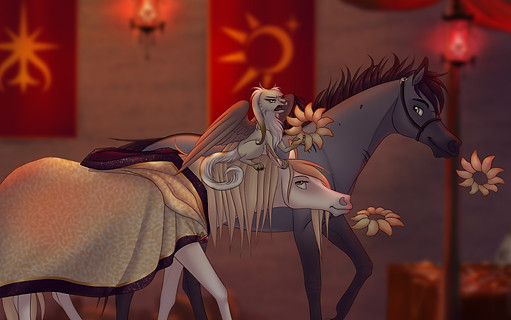
Most Korunians own a Raccardi slave, especially Commonfolk and High Society. While you don't have to let your character own one, it is still strongly recommended. You can either design your own or choose one listed in the Raccardi Market (available freely on the group page)
More information can be found on the lore pages. The section for Koruna in particular can be found here.